Full-mouth reconstruction · Prague 9
We treat extensive damage as one coherent plan.
We combine implantology, prosthetics and root canal treatment so that the result works as a whole over the long term — not as a series of separate procedures.
We speak English. The booking form is in Czech — email or call us if you prefer.
Our philosophy
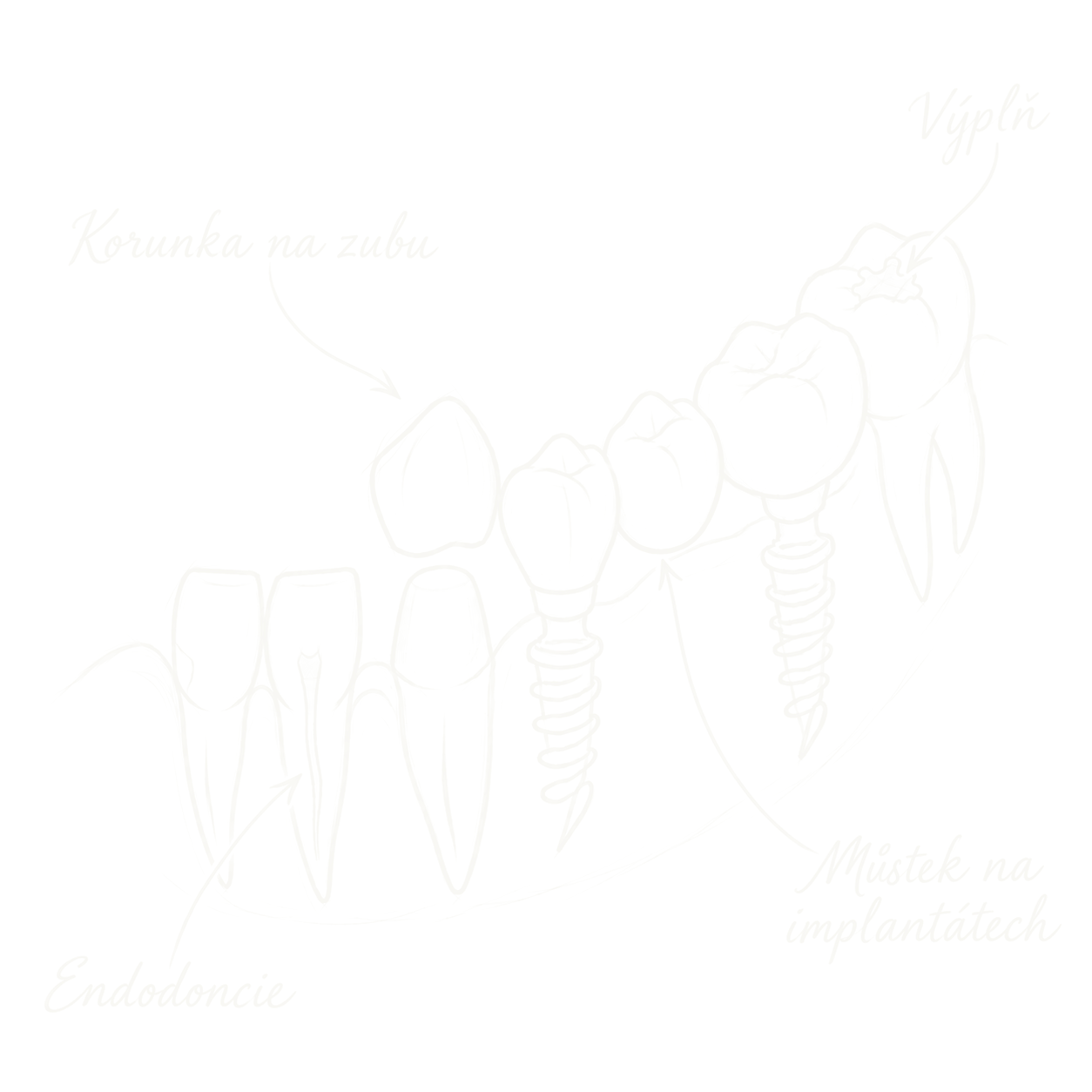
A reconstruction is not a set of procedures. It is one decision about the whole dentition.
With extensive findings, what matters is not how many procedures we do but in what order and with what goal. The wrong order of phases can spoil even technically good work.
We first stabilise the biological conditions, then save the teeth that have a prognosis, and only then replace what is missing. A tooth with a good outlook belongs in the plan — even if it would be easier to remove it.
Clinical case
Saving a tooth and prosthetic reconstruction
Drag the slider to compare the X-ray before and after treatment. We only publish images with the patient’s consent.
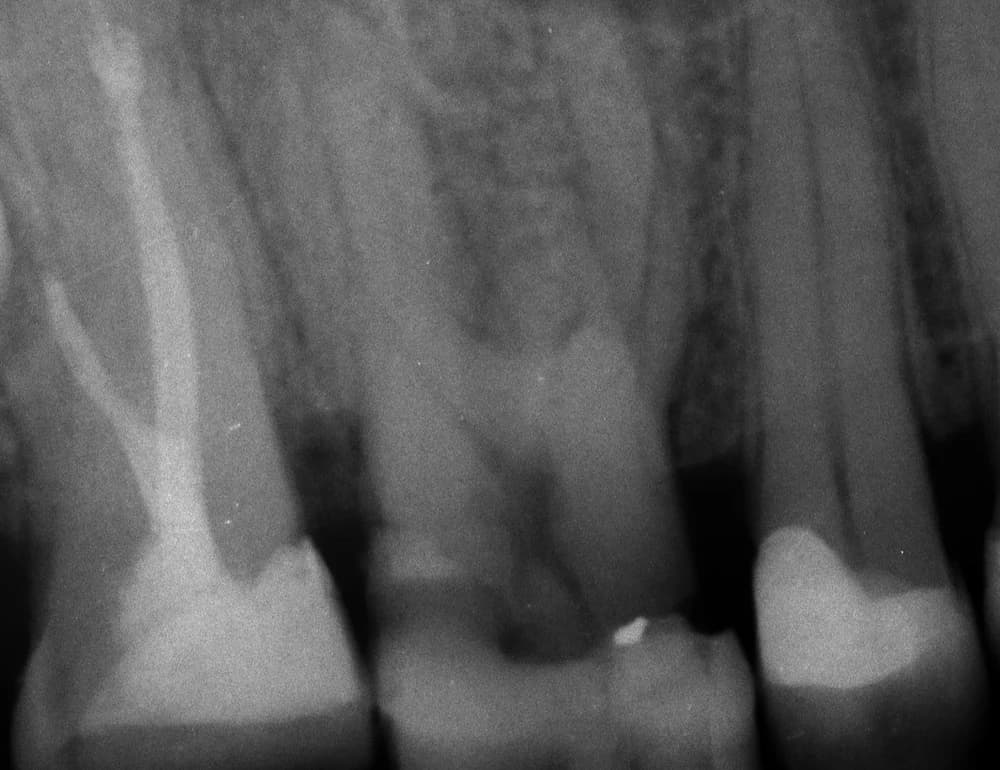
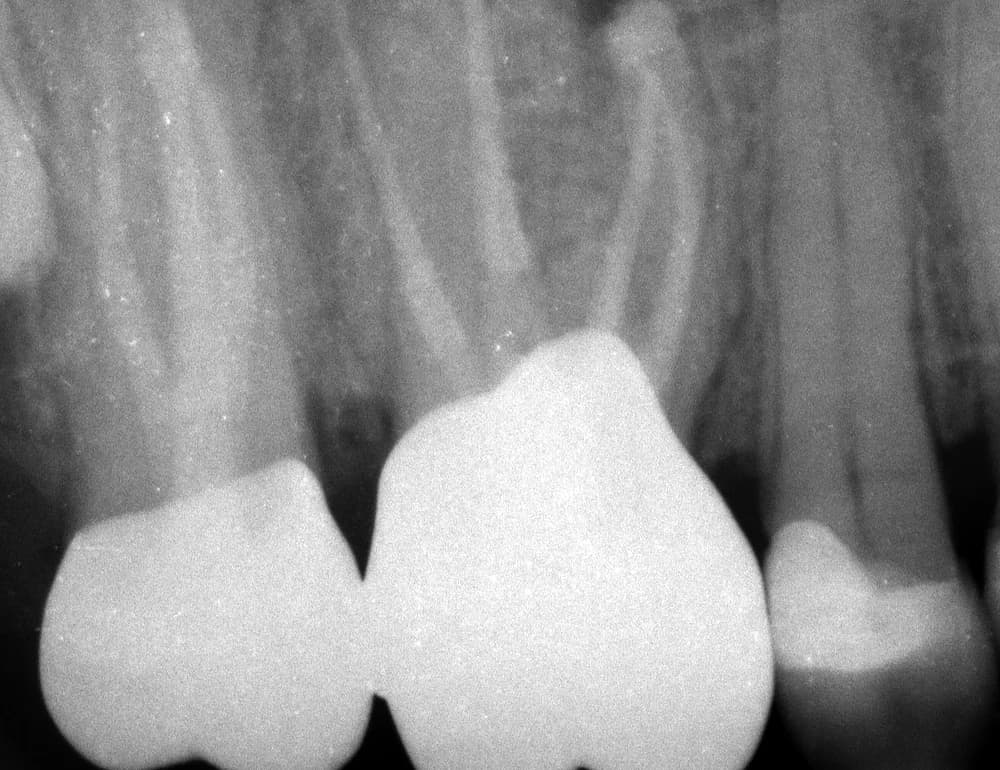
Microscopic endodontics and prosthetic reconstruction
Endodontics · prosthetics · X-ray
Our view
Saving your own teeth comes first; implants complement them.
We first look for teeth that can be kept. Those with a good prognosis stay, and gaps are filled with implants — we consider a combined solution better than replacing the whole dentition at once. We remove all teeth only when they truly cannot be used sensibly.
The reason is not just sentimental. Your own tooth hangs in the bone on the periodontal ligament, which contains pressure receptors (proprioception). Thanks to them the brain senses bite force and the texture of food precisely. An implant fuses directly with the bone and has no such feedback.
That is why full-mouth reconstruction sits at the meeting point of four fields — periodontology, endodontics, prosthetics and implantology. The decision which tooth to save and which to replace cannot be made from the viewpoint of only one of them.
Nothing we can make works better than your own tooth.
Against the trend
Why we are not for “pull everything and place screws”
Extracting all teeth and placing a full-arch bridge is a common offer today — it is fast, sells well and looks impressive at first glance. For a patient who still has teeth with a good prognosis, it is usually not the best choice.
We do full-arch solutions — and gladly. But at the point when your own teeth really cannot be kept sensibly.
- —Implants are not free of complications — inflammation around implants (peri-implantitis) occurs in roughly a fifth of patients according to review studies.
- —The cause of tooth loss does not disappear — patients who lost teeth to periodontitis have a higher risk around implants too.
- —Bone loss is permanent — every extracted tooth reduces the space for future solutions.
- —A healthy tooth is not an obstacle — removing a tooth with a good prognosis just to simplify the plan is bad medicine.
Combined solution
Own teeth where they have a future. Implants where teeth are missing.
The best reconstruction is often neither “everything on implants” nor “save everything at any cost”. It is a thought-through combination in which every tooth and every implant has its role.
How we decide
Every tooth goes into one of three categories
After complete diagnostics — clinical examination, CBCT, periodontal status and bite analysis — we assess the prognosis of each tooth separately. The plan grows from that.
- —root inflammation or a finding on the X-ray
- —previously poorly treated canals
- —periodontitis with enough bone
- —extensive decay above the bone level
- —large old fillings
- —cracks in the enamel
- —a root-filled tooth without a crown
- —wear from the bite
- —a vertical root fracture
- —decay deep below the bone
- —advanced bone loss with marked mobility
- —not enough healthy tissue for a crown
When we recommend removing a tooth, we explain why — and show you what saving it would mean. The decision is always made together.
FAQ
What patients ask most often
Isn’t an implant simpler and more permanent?+
An implant is excellent where a tooth is missing or cannot be saved. But it is not immune to complications. A saved tooth and an implant have a similar long-term prognosis — the tooth also preserves bone, sensation and the option of an implant later.
Elsewhere I was told the tooth must be extracted. Is a second opinion worth it?+
Yes. A recommendation to extract often depends on the equipment and specialisations a clinic has. With a microscope, CBCT and periodontal treatment, teeth once considered lost can sometimes be saved. Just bring the X-rays you have.
Can I have my own teeth and implants in the same jaw?+
Yes, and it is often the best option. We design the plan so that your own teeth and implants work together, each carrying its own load.
What if saving the tooth doesn’t work?+
An implant is still possible. That is why we offer saving a tooth only when it has a realistic prognosis — and say openly when the chances are poor.
How much does a full-mouth reconstruction cost?+
Extensive reconstructions are always individual — we set the price after the examination and the treatment plan, not as a flat fee in advance.
Let’s discuss the extent of your case
After complete diagnostics you get one clear plan instead of a series of unrelated procedures.
The online booking form is in Czech — you can also email info@d3nt.cz or call +420 777 585 233.